Full body laser hair removal for men usually means treating several large areas, such as the chest, back, arms, and legs, across a series of sessions spread out over months. It’s a hair reduction treatment, not a one-visit fix, and the results you get depend on your skin, your hair, the laser being used, and how closely you stick to the treatment schedule.
This guide to full body laser hair removal for men walks through what “full body” actually covers, how the laser affects hair, why several sessions are needed, what a session feels like, and what results look like over time.
What Is Full Body Laser Hair Removal for Men?
Laser hair removal is a cosmetic treatment that uses concentrated light to damage hair follicles, the small structures under the skin that produce each hair. A follicle that’s been damaged enough grows back finer, slower, or not at all.
“Full body” simply means treating many areas of unwanted body hair as part of one plan, instead of focusing on a single spot like the back or underarms. It isn’t a medical term, and it doesn’t mean every inch of skin is treated in one sitting.
Treatment is done as a course of sessions rather than once. At any given time, only some of your hair is in a stage where the laser can affect it well, so it takes repeat visits to reach more follicles.
For men, planning can look a little different. Body hair is often denser and coarser, and the areas involved tend to be larger. None of that makes treatment impossible, but it can shape how a provider sets the laser, how long sessions take, and how many visits are recommended.
What Areas Are Included in Full Body Laser Hair Removal for Men?
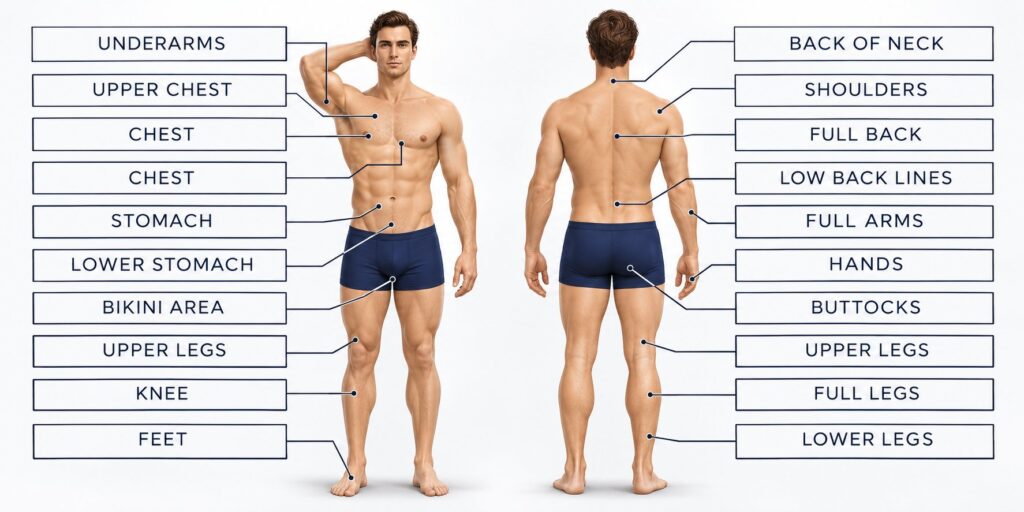
There’s no universal definition of “full body.” Each clinic decides what goes into its own package, so two offers with the same name can cover quite different areas. Always ask for the exact list before you commit.
The table below shows how areas are commonly grouped across the industry. It’s a general guide, not a description of any specific provider’s package.
| How it’s often handled | Areas | Why |
|---|---|---|
| Commonly included | Chest, abdomen, back, shoulders, arms, underarms, legs | These are the large, frequently treated body areas most men think of first |
| Sometimes included or optional | Feet and toes, back of the neck, buttocks | Small or less-requested areas that some packages add and others leave out |
| Often treated separately | Face (beard, cheeks, front of the neck), intimate areas | These areas usually need their own assessment, settings, and conversation about goals |
The face deserves a special mention. Many men want to keep a beard but tidy the cheek line or neck, which is a shaping decision, not just “remove everything.” Intimate areas are also typically discussed and booked on their own, and not every provider treats them.
If you’re looking at a specific clinic, its service page is the right place for provider-specific details. You can read about how BYou approaches this treatment on its dedicated service page for men.
How Does Laser Hair Removal Work?
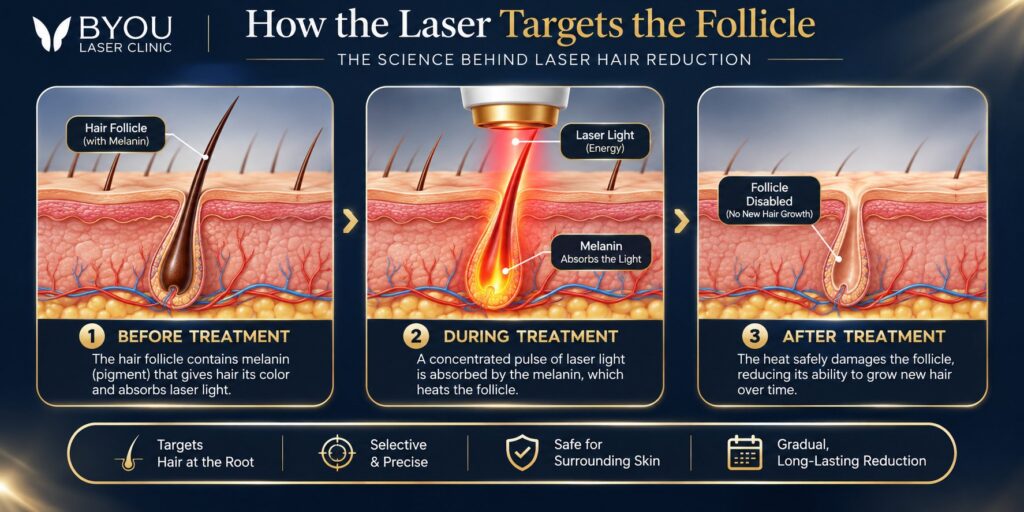
Laser hair removal works by targeting pigment in the hair. In plain terms, the process looks like this:
- The laser device sends pulses of light energy into the skin.
- Melanin, the pigment that gives hair its color, absorbs that energy.
- The energy turns into heat, which travels down the hair shaft and damages the hair follicle.
- Damaged follicles produce less hair over time, and that reduction builds with each session.
This is why darker hair generally responds better than very light hair. Blond, red, gray, or white hairs have little melanin, so they absorb less energy and may respond poorly or not at all. Many men’s chest, back, and abdominal hair is dark and coarse, which gives the laser a clear target, but gray hairs in those areas are unlikely to respond.
One session also can’t reach every hair. Hair grows in cycles, and the laser works best on hairs that are actively growing and still connected to the follicle. Hairs in a resting or shedding stage, or follicles that haven’t produced a visible hair yet, are less likely to be affected that day. They’ll be targeted in later sessions as they move into the growth phase.
Why Do Men Need Multiple Laser Hair Removal Sessions?
Multiple sessions are needed because your hair isn’t all growing at the same time. Each follicle runs on its own schedule, moving through three broad stages:
- Growing (anagen): the active growth phase, when the hair is attached to the follicle and responds best to the laser.
- Transition (catagen): a short phase when growth slows and the hair starts to detach.
- Resting (telogen): the hair is dormant or about to shed, and the laser has much less effect.
On treatment day, only the follicles in the active phase are ideal targets. The rest are waiting their turn. Treatment intervals are timed so that a new group of follicles has entered the growth phase by your next visit.
In other words, the hair growth cycle decides when the next session makes sense, and each well-timed session adds to the overall hair reduction.
Sessions are usually spaced several weeks apart, with the exact interval set by your provider. Most people need a series of sessions for each area, and there’s no single number that applies to everyone. Your number depends on the area, your hair density and color, your skin, hormones, and how your hair responds. Some men need more, and touch-ups later are common.
How Is Laser Hair Removal Different for Men?
The technology and the basic process are the same for everyone. What can differ is the hair and the scale of the job. A few factors often come up when planning men’s treatment:
- Hair density. Many men have more follicles packed into areas like the chest, back, and abdomen. More hair in one spot means more pigment absorbing energy, which may affect how a provider adjusts settings.
- Hair thickness. Coarse, dark hair often responds well to laser because it holds plenty of pigment. It can also take time for very dense growth to thin out noticeably.
- Larger treatment areas. A broad back or full legs simply take longer to cover than a smaller area, which affects session length.
- Differences between body areas. Chest hair, back hair, and leg hair don’t always behave the same way. One area may thin quickly while another takes longer.
- Hormonal factors. Androgens such as testosterone help drive male body hair growth. Hormones can keep stimulating some follicles over time, which is one reason maintenance sessions may be needed.
None of this means every man needs more sessions than every woman. Plenty of variation exists within both groups. These are just factors a provider looks at when shaping an individual plan. If you’d like a broader look at treatment options for men, BYou has a page on laser hair removal for men.
Is Full Body Laser Hair Removal Suitable for Everyone?
No. Whether full body laser hair removal for men suits you comes down to how four things fit together: your skin, your hair, the laser technology available, and the area being treated.
Skin tone and skin type. The laser is looking for pigment in the hair. Skin also contains melanin, and darker skin has more of it. With the wrong device or settings, skin can absorb energy meant for the hair, raising the risk of burns or changes in skin color. This doesn’t rule out darker skin tones. It means the provider has to choose technology and settings suited to that skin.
Hair color. The best candidates for traditional laser treatment have hair that’s darker than their skin. Light blond, red, gray, and white hair often respond poorly because there’s too little pigment to absorb the energy.
Hair thickness and density. Coarse, dense hair generally gives the laser more to work with. Very fine hair can be harder to treat.
The treatment area. Skin thickness, sensitivity, and hair patterns vary from area to area, which can change the approach.
Because these factors interact, nobody can tell you from an article whether treatment will work for your skin and hair. A consultation with a qualified provider, who can look at your skin and hair in person and review your history, is the right place to answer that question.
What Type of Laser Is Used for Men’s Full Body Hair Removal?
Several laser types are used for hair removal, and each works at a different wavelength, which affects how deeply the light travels and how strongly melanin absorbs it. Three come up most often:
| Laser type | Wavelength | Commonly considered for |
|---|---|---|
| Alexandrite | 755 nm | Lighter skin tones with darker hair |
| Diode | Around 800–810 nm | A fairly broad range of skin tones and hair types |
| Nd:YAG | 1064 nm | Darker skin tones, because it penetrates deeper and is less absorbed by pigment at the skin’s surface |
These are general tendencies, not hard rules. No single laser is the best choice for every person. Which device makes sense can depend on your skin tone, your hair color and thickness, the area being treated, the equipment a provider has, and the treatment protocol they follow. Some clinics use more than one type.
Most modern laser devices also include a cooling system, such as a chilled tip, cold air, or a cooling spray. Cooling helps protect the top layer of skin and can make treatment more comfortable.
Which technology a clinic uses is a fair thing to ask, and a provider should be able to explain why their device suits your skin and hair.
How to Prepare for Full Body Laser Hair Removal
Preparation is mostly about leaving the follicle in place and keeping your skin calm. Your provider will give you their own instructions, and those come first. The points below are common general guidance, in line with the advice published by the American Academy of Dermatology.
Shave, don’t wax. Shaving is usually recommended shortly before a session, on the timing your provider gives you. It clears hair above the skin so the energy goes to the root instead of heating hair on the surface, and it leaves the follicle intact for the laser to target. For hard-to-reach spots like the back, ask whether you should shave yourself or whether the clinic handles it.
Avoid waxing, plucking, and epilating. These pull the hair out by the root, which removes the very target the laser needs. Providers usually ask you to stop these methods for a set period before treatment and will tell you how long.
Limit tanning and sun exposure. Recent tanning, whether from the sun, tanning beds, or self-tanner, adds pigment to the skin. That can make treatment riskier and may lead a provider to adjust settings or postpone the session. Protecting treated areas with clothing and sunscreen in the weeks before is a common recommendation.
Keep skin prep simple. Arrive with clean skin, without heavy lotions, deodorant on the underarms, or irritating products on the areas being treated. Avoid harsh exfoliants or new skincare in the days before if your skin tends to react.
Tell your provider about medications and skin conditions. Some medications can make skin more sensitive to light, and active skin issues in a treatment area may need attention first. Share any new prescriptions, recent sunburn, rashes, or history of cold sores or keloid scarring before your session, not after.
What Happens During a Full Body Laser Hair Removal Session?
Every clinic has its own routine, but most sessions follow a similar pattern:
- Consultation or assessment. Before your first treatment, a provider typically reviews your skin, hair, medical history, and goals. Some providers also do a small test patch to see how your skin reacts.
- Preparing the treatment areas. The skin is cleaned, and any missed hair may be shaved. Some providers mark out larger areas so each section is covered evenly.
- Protective measures. You and the provider wear protective eyewear designed for the laser’s wavelength, since laser light can damage the eyes.
- Laser treatment. The provider moves the laser device across each area in a systematic pattern, delivering pulses as they go. The device’s cooling helps protect the skin’s surface.
- Post-treatment instructions. Afterward, you may get a soothing product on the skin and a rundown of aftercare for the next few days.
How long it takes depends on how many areas are being treated and how large they are. A full set of large body areas takes noticeably longer than a single zone, and some clinics may split a full body plan across more than one appointment. Your provider can give you a realistic time estimate for your plan.
What Does Full Body Laser Hair Removal Feel Like?
Most people feel something, so it isn’t completely painless. The discomfort is usually brief, and many people find it manageable.
Common sensations include:
- Warmth or heat on the skin as each pulse is delivered.
- A snapping or pinching feeling, often compared to a rubber band flicked against the skin.
- Temporary discomfort that tends to be stronger in areas with dense, dark hair or thinner, more sensitive skin.
- Cooling from the device, which many people find takes the edge off.
Sensations vary a lot from person to person and from area to area. Some people notice treatments get more comfortable over time as the hair thins and there’s less pigment absorbing heat.
If something feels like more than you expected, say so during the session. Providers can often adjust their pace, settings, or cooling, and you can ask what comfort options they offer.
What Should You Expect After Treatment?
Most reactions after a session are mild and short-lived, though everyone’s skin responds a little differently.
Temporary skin reactions. Redness and small raised bumps around the follicles are common right after treatment. The skin may feel warm, a bit like a mild sunburn, and can stay sensitive for a few hours to a couple of days. Contact your provider if you notice blistering, crusting, significant swelling, or changes in skin color.
What happens to the treated hairs. Treated hairs don’t usually vanish on the spot. In the days and weeks after a session, many of them shed. This can look like new growth at first, since the hairs are pushed out of the follicle, but they typically fall out or wipe away easily. Gentle washing and exfoliation, if your provider okays it, can help.
Common aftercare considerations. Providers often recommend:
- avoiding hot showers, saunas, hot tubs, and intense workouts for a short period, since heat and sweat can irritate treated skin;
- skipping fragranced or harsh products on treated areas for a few days;
- not picking at bumps or pulling out shedding hairs;
- shaving between sessions if needed, but not waxing or plucking.
Sun exposure. Treated skin can be more sensitive to the sun, and tanning between sessions can raise the risk of irritation or pigment changes. Covering up and using a broad-spectrum sunscreen is commonly advised throughout the treatment course.
Your provider’s aftercare instructions are based on your skin, the settings used, and their protocol, so follow those over any general advice, including this article.
How Long Does It Take to See Results?
Results build gradually. After the first session, you might notice some shedding and patchier regrowth, but the change is usually modest. Each later session reaches a new group of follicles as they cycle into the growth phase, so hair reduction tends to become more noticeable as the course goes on.
The progression usually looks something like this:
- Early sessions: some shedding, slower regrowth in places, hair that grows back a bit finer.
- Middle of the course: thinner coverage, larger patches with little regrowth, less frequent shaving.
- Toward the end of the course: a clearer overall reduction, with remaining hairs often lighter and finer.
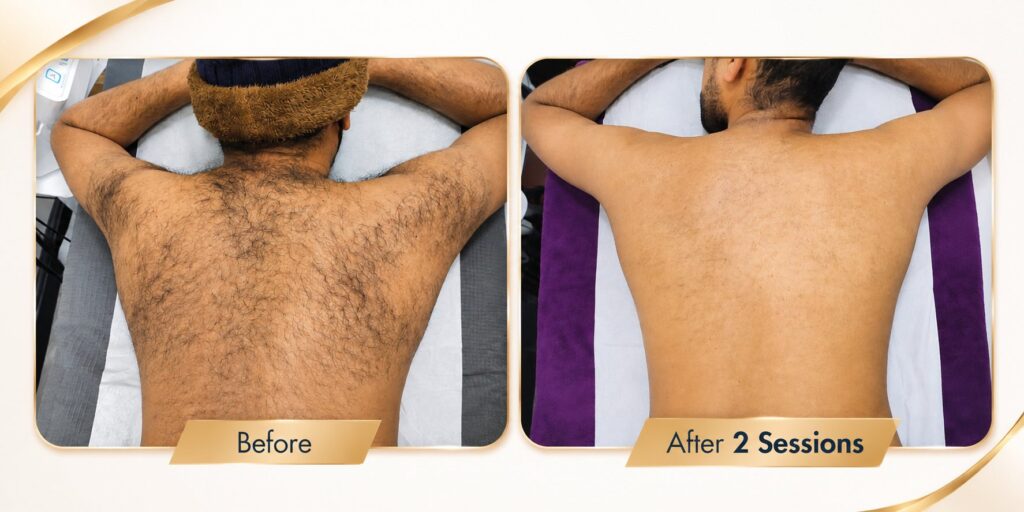
Because body hair cycles take time, a full course of full body laser hair removal for men typically spans many months. How quickly you see change depends on the area, your hair color and density, your hormones, and how consistently you keep appointments. Skipping or delaying sessions can slow progress. After the initial course, some men also need occasional maintenance sessions to manage regrowth.
Laser treatment aims for significant, long-term hair reduction. It isn’t designed to guarantee that 100% of hair disappears, and no provider can promise a specific result by a specific date.
How Long Do the Results Last?
Hair reduction from a completed course is often long-lasting, but it isn’t always permanent for every hair.
The initial treatment course is the series of sessions designed to reduce as much hair as reasonably possible in each area. Follicles that were damaged enough may stop producing hair or produce only fine, light hair.
Some regrowth is still possible. A portion of follicles survive treatment, and others may become active later because of hormonal changes, age, or individual biology. When hair does return, it’s often lighter and sparser than before.
That’s where maintenance treatments come in. Occasional touch-up sessions, sometimes spaced months apart, can help manage regrowth. How often you need them, if at all, varies from person to person.
So a completed course can lead to a substantial, lasting reduction in body hair, but it can’t guarantee that every hair is gone for good.
Who May Need to Delay or Avoid Laser Hair Removal?
Some situations don’t rule out treatment forever but may call for postponing a session, extra assessment, a change in the plan, or a conversation with a doctor first. Common examples include:
- A recent tan or sunburn. Extra pigment or irritated skin can raise the risk of side effects, so providers often wait until the skin settles.
- Active skin conditions in the treatment area, such as a rash, infection, open wounds, or a flare of eczema or psoriasis.
- A history of cold sores near a treated area, which some providers address before treatment.
- Medications that increase photosensitivity, meaning they make skin more sensitive to light. Never stop a prescribed medication on your own; talk to your prescribing doctor.
- A tendency toward keloid scarring or unusual skin reactions, which may need extra caution.
- Tattoos in the treatment area, since the ink can absorb laser energy. Providers typically work around them.
- Ongoing skin irritation from shaving, products, or friction, which may need time to calm down first.
This isn’t a complete list, and it isn’t a way to decide on your own whether treatment is right for you. Bring up your full health history at the consultation so a qualified professional can assess your situation.
Full Body Laser Hair Removal vs. Treating Individual Areas
You don’t need to treat your whole body to get value from laser hair removal. Some men want broad coverage; others only care about one or two areas. Both are valid, and the right choice depends on your goals.
| Full body treatment | Individual treatment areas | |
|---|---|---|
| What it covers | Multiple areas treated under one plan | One or a few areas you choose |
| Session length | Longer, since more skin is covered | Shorter |
| Planning | One treatment plan coordinating several areas | Simpler; areas can be added later |
| Good fit if | You want reduction across most of your body | Only certain areas bother you, or you want to try treatment first |
| Things to weigh | Bigger time commitment per visit; areas may progress at different rates | Treating areas one by one can mean more separate appointments over time |
Starting with one area and adding more later is a common approach. It lets you see how your skin and hair respond before committing to a larger plan. On the other hand, treating multiple areas together keeps everything on a single schedule.
Whether you choose full body laser hair removal for men or start with a single area, the practical details, like which areas are available and how sessions are scheduled, vary by provider. For BYou’s own approach, see its men’s treatment page.