Labor Day is behind you, the umbrellas are gone from Long Beach, and the mirror is telling a different story than it did in June. A few new brown spots on your cheeks. Skin that looks uneven in daylight. A dry, tight feeling that moisturizer doesn’t quite fix.
That’s what a season of sun, salt water and wind tends to leave behind, and fall happens to be a practical time to start sun damage treatment. This guide explains what the sun actually did to your skin, which marks need a doctor rather than a cosmetic treatment, what you can do at home, how in-clinic options compare, and how to plan a course of care from November through spring.
What Does Sun Damage Look Like After Summer?
Sun damage is the visible result of ultraviolet (UV) radiation breaking down the structures that keep skin even and firm. It usually shows up as some mix of spots, uneven tone, rough texture, fine lines and redness.
Two types of UV do most of the work. UVB rays hit the outer layer of skin and cause most sunburns. UVA rays reach deeper, into the dermis, where they break down collagen, the protein that gives skin its structure. Both prompt pigment cells to produce extra melanin as a defense, which is why sun leads to a tan and, over the years, to hyperpigmentation. Dermatologists call the long-term result photoaging.
The effects rarely appear all at once. Pigment builds gradually, and collagen damage takes months to show up as texture changes. Many people only see the full picture in September or October, once the tan fades and the skin underneath looks patchier than expected.
Coastal summers add another layer of exposure. Sand and water bounce UV back up at you, so an umbrella doesn’t block all of it. According to the World Health Organization, dry beach sand reflects about 15% of UV radiation and sea foam about 25%. A day at Jones Beach or on the Long Beach boardwalk adds up to more UV than the same hours in a backyard.
Most post-summer damage falls into four patterns, and each responds to different care.
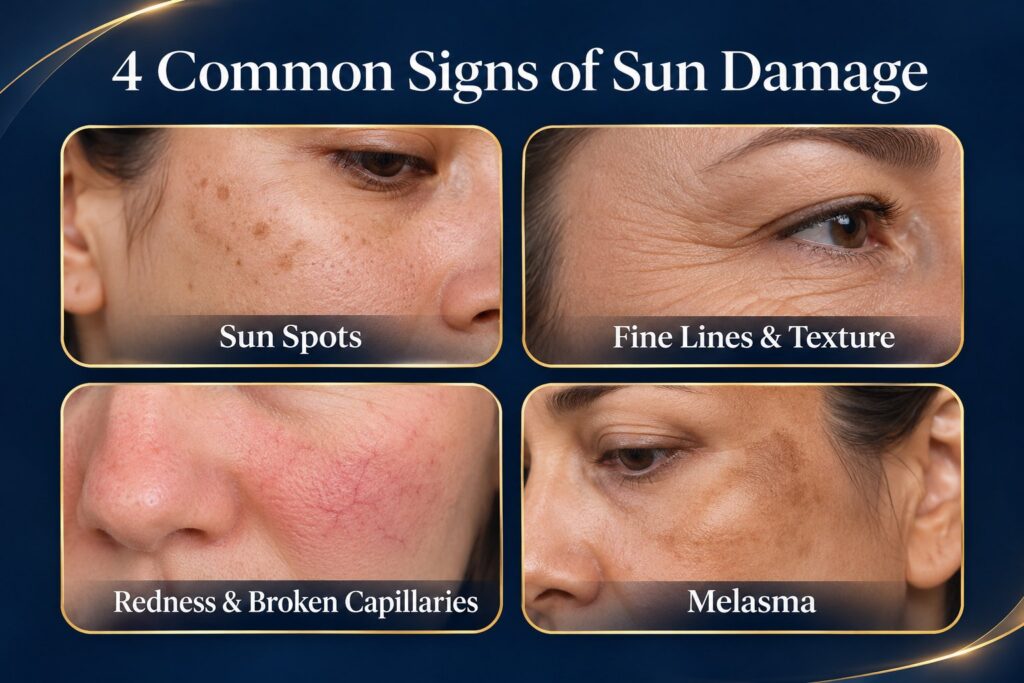
Sun Spots and Uneven Skin Tone
Sun spots, also called age spots or liver spots, are flat brown spots with defined edges. They show up where skin gets the most sun: the face, the backs of the hands, the chest and the shoulders. Their color ranges from light tan to dark brown.
Freckles are different. They’re usually small, often genetic, appear in childhood, and tend to fade in winter and darken in summer. Sun spots stay put year-round and usually appear later in life.
Uneven skin tone comes from the same process on a wider scale. Instead of one clear spot, extra melanin settles in patches, which gives skin a blotchy or dull look. When discoloration is spread out like this, it’s usually approached as a broader pigmentation concern rather than spot by spot.
If you’ve been searching for how to get rid of sun spots on your face, start by working out whether you have distinct spots, diffuse discoloration or both. The treatments differ.
Fine Lines, Rough Texture and Enlarged Pores
UVA exposure breaks down collagen and elastin faster than your body replaces them. After several summers, that collagen loss tends to show up as:
- fine lines and wrinkles around the eyes and mouth that look deeper than before;
- rough, dry or slightly leathery skin texture, especially on the cheeks and forehead;
- enlarged pores, because the skin around them has lost some of its support.
Treatment can improve texture and stimulate new collagen, but it works gradually and doesn’t erase years of exposure.
Redness and Broken Capillaries
Persistent facial redness and small visible blood vessels on the nose and cheeks are common after years of sun. These are often called broken capillaries or spider veins on the face. UV exposure weakens the vessel walls and the collagen around them, so the vessels become easier to see over time.
Redness has several possible causes, including rosacea, which only a medical professional can diagnose. If your face also flushes easily or stings with products, mention it to a dermatologist or at your consultation.
Melasma: Why It Needs a Different Approach
Not every dark patch is a sun spot. Melasma appears as larger, blotchy brown or gray-brown patches, often on both cheeks, the forehead, the upper lip or the nose. It’s driven mainly by hormones, which is why it’s common during pregnancy, and sun exposure and heat make it worse.
Melasma is treated differently from sun spots. Aggressive treatments that work on a single sun spot can irritate melasma-prone skin and make the patches darker. That’s why any dark patch should be assessed at a consultation before a procedure is booked. BYou explains its approach on the melasma page.
When Should You See a Dermatologist About a Spot?
Most sun spots are harmless, but sun exposure also raises the risk of skin cancer, and some spots need a doctor rather than a cosmetic treatment. See a dermatologist first if a spot:
- changes in size, shape or color;
- bleeds, itches or doesn’t heal;
- feels rough or scaly, like sandpaper.
A rough, scaly patch can be an actinic keratosis, which the Skin Cancer Foundation describes as the most common precancer. It comes from long-term UV exposure and is often easier to feel than to see.
For moles and darker spots, dermatologists use the ABCDE rule: Asymmetry, an uneven Border, more than one Color, a Diameter often larger than a pencil eraser, and Evolving, meaning the spot changes over time.
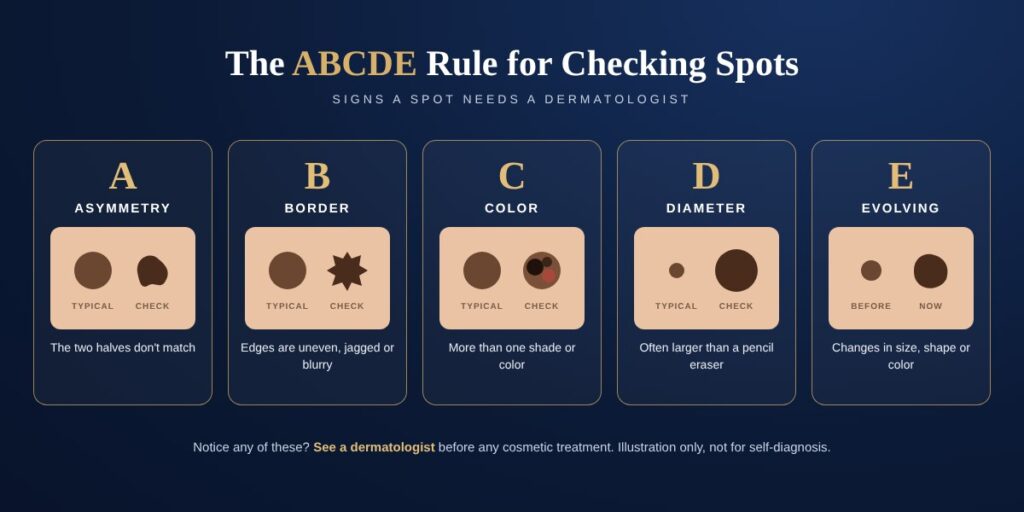
A laser clinic does not diagnose skin cancer. Any spot that looks suspicious should not be treated cosmetically until a doctor has examined it, because removing or lightening it can make important changes harder to track.
How Can You Repair Sun Damaged Skin at Home?
Home care won’t remove established sun spots, but it does two important jobs: it stops new damage, and it slowly evens out tone and texture. Anyone figuring out how to repair sun damaged skin should start here, because in-clinic results don’t hold up without it.
- Daily broad-spectrum sunscreen, SPF 30 or higher. Broad-spectrum means it protects against both UVA and UVB. Keep wearing it in winter, since UVA is present year-round and passes through clouds and car windows.
- Vitamin C in the morning. This antioxidant helps defend skin against UV-related damage and can gradually brighten dull tone. Apply it under your sunscreen.
- A retinoid at night. Retinoids speed up cell turnover and support collagen over time, which helps with texture, fine lines and some pigment. Start slowly, since they can cause dryness and irritation at first.
- Moisturizer and barrier repair. Sun, salt water and wind leave the skin barrier depleted. A moisturizer with barrier-supporting ingredients, such as ceramides, eases dryness and helps skin tolerate active products and treatments.
One note on retinoids: they make skin more sensitive, so providers often ask you to pause them for a few days before treatments such as peels, laser or microneedling. Your provider will give you the exact timing.
What Is the Best Treatment for Sun Damaged Skin?
The best treatment for sun damaged skin depends on the type of damage, not on the name of the procedure.
| Problem | Treatments that may help |
|---|---|
| Sun spots | Laser spot removal; chemical peels |
| Uneven tone and dullness | Chemical peels; Laser Genesis; hydrating facials |
| Fine lines and texture | Microneedling; RF microneedling (Morpheus8); Laser Genesis |
| Enlarged pores | Laser Genesis; microneedling; chemical peels |
| Redness | Laser Genesis |
| Loss of firmness | RF microneedling (Morpheus8) |
Most people have more than one of these, and a combination treatment often works better than any single option. One example is spot removal for a few distinct spots, paired with a series of peels or Laser Genesis for overall tone. The treatment plan should be set after a skin assessment that looks at your skin type, the type and depth of damage, your history and your goals.
Laser Treatment for Sun Damage
Laser treatment for sun damage uses light energy aimed at a specific target in the skin, such as excess pigment or small blood vessels.
For sun spot removal, laser spot removal is the most direct option. The pigment absorbs the laser energy, and there’s typically no downtime, so you can go straight back to your day. Over the following days, the treated spot usually darkens and then flakes off as the skin renews. That’s an expected part of the process rather than a recovery period, and the flakes should be left to shed on their own. Darker or larger spots may need more than one session.
For redness, uneven texture and enlarged pores, Laser Genesis is a gentler option. It gently warms the deeper layers of skin without breaking the surface, so there’s little to no downtime, though mild redness can linger briefly. Results build gradually, which is why it’s usually done as a series.
Session numbers, recovery times and the devices used vary by clinic and by person. Confirm the details at your consultation.
Chemical Peels
A chemical peel uses an acid solution to remove the outer layers of skin in a controlled way. That exfoliation helps with uneven tone, dullness and surface spots, and can soften fine texture.
Peels come in different depths. Superficial peels work on the outermost layer with little visible peeling, while medium-depth peels go further and usually involve several days of flaking. The right peel depth depends on your skin type, the kind of damage and how much downtime you can accept. For many people, a series of lighter peels spaced a few weeks apart works better than one strong peel, especially for skin that’s prone to pigment changes.
Microneedling and RF Microneedling
Standard microneedling uses very fine needles to create controlled micro-injuries in the skin. Skin responds by ramping up collagen production, which can gradually improve fine lines, texture and the look of pores.
A related option, RF microneedling with Morpheus8, adds radiofrequency energy delivered through the needles. The heat reaches deeper layers and supports skin firmness, which makes it worth considering when sun damage has also caused some laxity. BYou’s Morpheus8 page describes temporary redness and pinpoint marks that settle within a few days; your provider will confirm what to expect for your treatment area.
Hydrating Facials
After a summer of sun, salt water and wind, many people’s main complaint is simply skin that feels dry, tight and dull.
A hydrating facial is a gentle starting point. An Aquapure Facial, for example, combines exfoliation with a hydrating serum infusion and has no downtime. It won’t remove sun spots, but it works well as a first step and as maintenance between stronger treatments.
Why Are Fall and Winter the Best Time for Sun Damage Treatment?
Fall and winter are the most practical time to treat sun damage because there’s less UV working against you. The reasoning runs in a chain:
- Less sun means a lower risk of post-inflammatory hyperpigmentation, the darkening that can happen when healing skin is exposed to UV.
- Lower risk makes aftercare easier, with no beach days, outdoor sports or summer events to work around.
- Starting in November leaves time for a full treatment course before beach season returns.
Many treatments, including peels, lasers and retinoid routines, also cause temporary photosensitivity, meaning skin burns or reacts to sun more easily for a while. That’s far easier to manage on Long Island in January than in July, and it’s a big reason winter skin treatments appeal to anyone who spends summers outdoors.
A simple seasonal plan might look like this:
| Months | Focus |
|---|---|
| November–December | Consultation, skin assessment and first sessions |
| January–March | Main treatment course |
| April–May | Maintenance sessions and strict daily SPF |
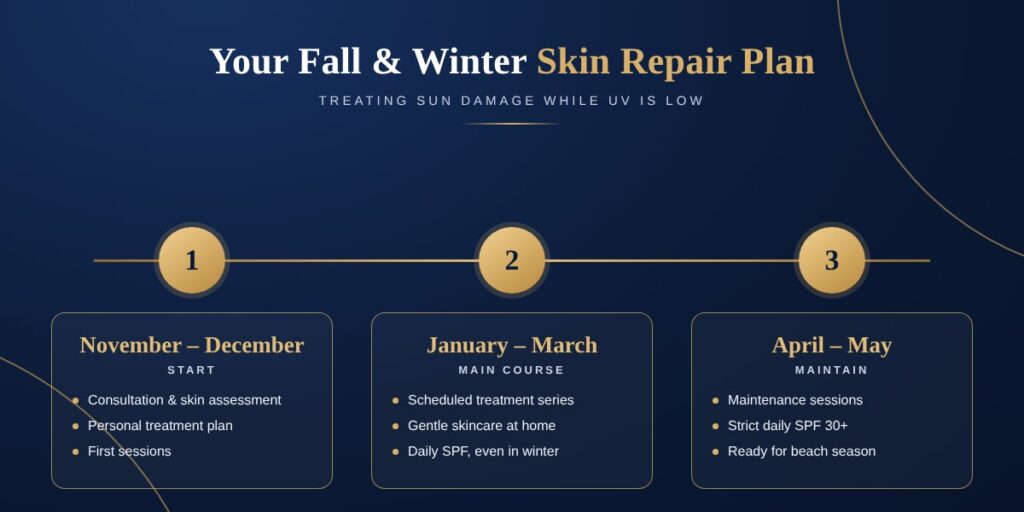
Winter isn’t UV-free, though. The WHO notes that snow can reflect as much as 80% of UV radiation, so sunscreen stays part of the routine all season.
How Many Sessions Will You Need, and When Will You See Results?
Results develop gradually, and the number of treatment sessions depends on:
- the type of damage, such as a single sun spot versus widespread changes in tone or texture;
- how deep the damage goes;
- your skin type;
- the treatment, or combination, you choose.
As a general pattern, distinct sun spots may respond within one or a few sessions. Texture, pores and firmness usually need a series spaced several weeks apart, because new collagen takes months to form. Skin renewal takes time too, so the clearest improvement often shows a few weeks after a session rather than the next morning.
Most plans also include maintenance, since every new summer brings new exposure. Typical ranges vary from person to person, and no provider can promise a set number of sessions, a specific result or a guaranteed timeframe.
Is It Safe to Treat Sun Damage on Darker Skin?
Many people with darker skin can treat sun damage, but it calls for more care in planning. Dermatologists describe skin with the Fitzpatrick scale, from type I (very fair, always burns) to type VI (deeply pigmented, rarely burns). Skin types IV–VI have more active pigment cells, so a treatment that’s too aggressive, or settings that don’t suit the skin, can trigger post-inflammatory hyperpigmentation: new dark patches where the skin was treated.
That makes three things matter more for darker skin:
- Treatment choice. Some lasers and peel depths are better suited to darker skin than others.
- Treatment settings. Energy, depth and intervals often need a more conservative approach.
- Provider experience. Ask how often the provider treats your skin type and how they adjust for it.
No treatment is risk-free for any skin type, which is why an in-person assessment should come before any procedure.
How Should You Prepare for Treatment and Care for Your Skin Afterward?
Your provider’s instructions come first, since they depend on the treatment and your skin. The steps below are common general guidance.
Before treatment
- Avoid tanning, tanning beds and self-tanner for the period your provider specifies.
- Pause retinoids and strong exfoliants, such as acids and scrubs, if advised.
- Tell your provider about medications, supplements and skin conditions, including a history of cold sores.
- Arrive with clean skin and no makeup on the treatment area.
After treatment
- Stick to gentle skincare: a mild cleanser and a plain moisturizer.
- Apply broad-spectrum SPF 30 or higher every day, and reapply when you’re outdoors.
- Avoid direct sun, saunas and intense workouts for as long as your provider recommends.
- Don’t pick at flaking skin or darkened spots; let them shed on their own.
Restart retinoids and other active products only when your provider says your skin is ready.
Where to Start: Sun Damage Treatment at BYou Laser Clinic in Oceanside
If you live on the South Shore and want to use the cooler months well, the first step is a free consultation. Our team at BYou Laser Clinic in Oceanside starts every plan with a skin assessment: what kind of damage you have, your skin type, any spots that should see a dermatologist first, and what you want your skin to look like by spring.
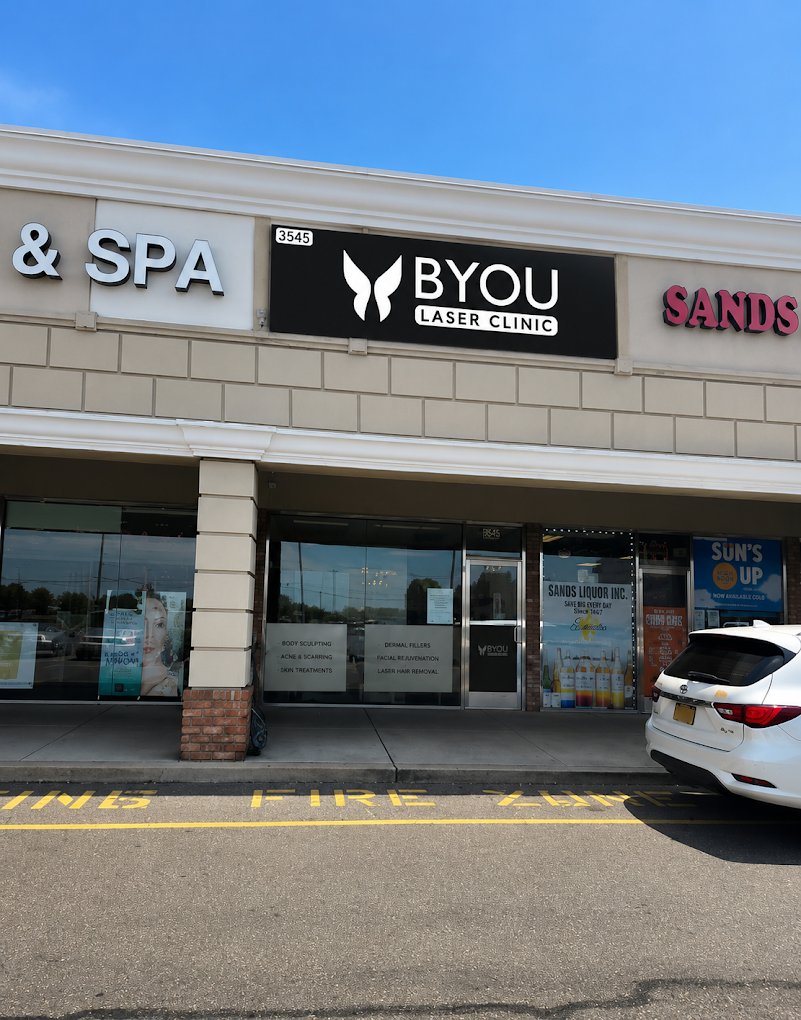
From there, you get a personal fall and winter plan. Depending on your assessment, it may draw on treatments covered in this article, including laser spot removal, Laser Genesis, chemical peels, microneedling, Morpheus8 and hydrating facials. The clinic treats all skin types, Fitzpatrick I–VI, and chooses settings for your skin rather than a one-size approach.
The clinic sits at 3545 Long Beach Rd, Oceanside, NY 11572, a short drive from Long Beach, Island Park, Lynbrook and Rockville Centre. If you’d like to get the first sessions in before the holidays, book a consultation at our Oceanside clinic on Long Beach Rd and give the next few months time to work.
Frequently Asked Questions
Can sun damage be reversed?
Not completely. Sun spots, uneven tone and rough texture can often improve noticeably with the right treatment and daily sun protection. Deeper collagen loss improves more slowly and only partly. The realistic goal is visible improvement and preventing new damage, not erasing years of sun. How much changes depends on your skin type, the depth of damage and how consistent you are with care.
Do I really need sunscreen in winter?
Yes. UVA rays, which drive photoaging and pigment, are present year-round and pass through clouds and windows. Snow can also reflect a large share of UV back onto your face. During a treatment course, daily SPF 30 or higher matters even more, because treated skin is more sensitive and new sun exposure can set back your progress.
This article is for general information only and isn’t a substitute for medical advice. Any new or changing spot should be checked by a dermatologist.